 MedLab Basics
Study sheet
Specimens, Cultures and Susceptibility Testing
Collection, transport and rejection by site, blood, urine, CSF, respiratory, stool and genital cultures, AST methods and breakpoints, MRSA, D-test, ESBL, AmpC, carbapenemases, VRE, expected resistance and reporting
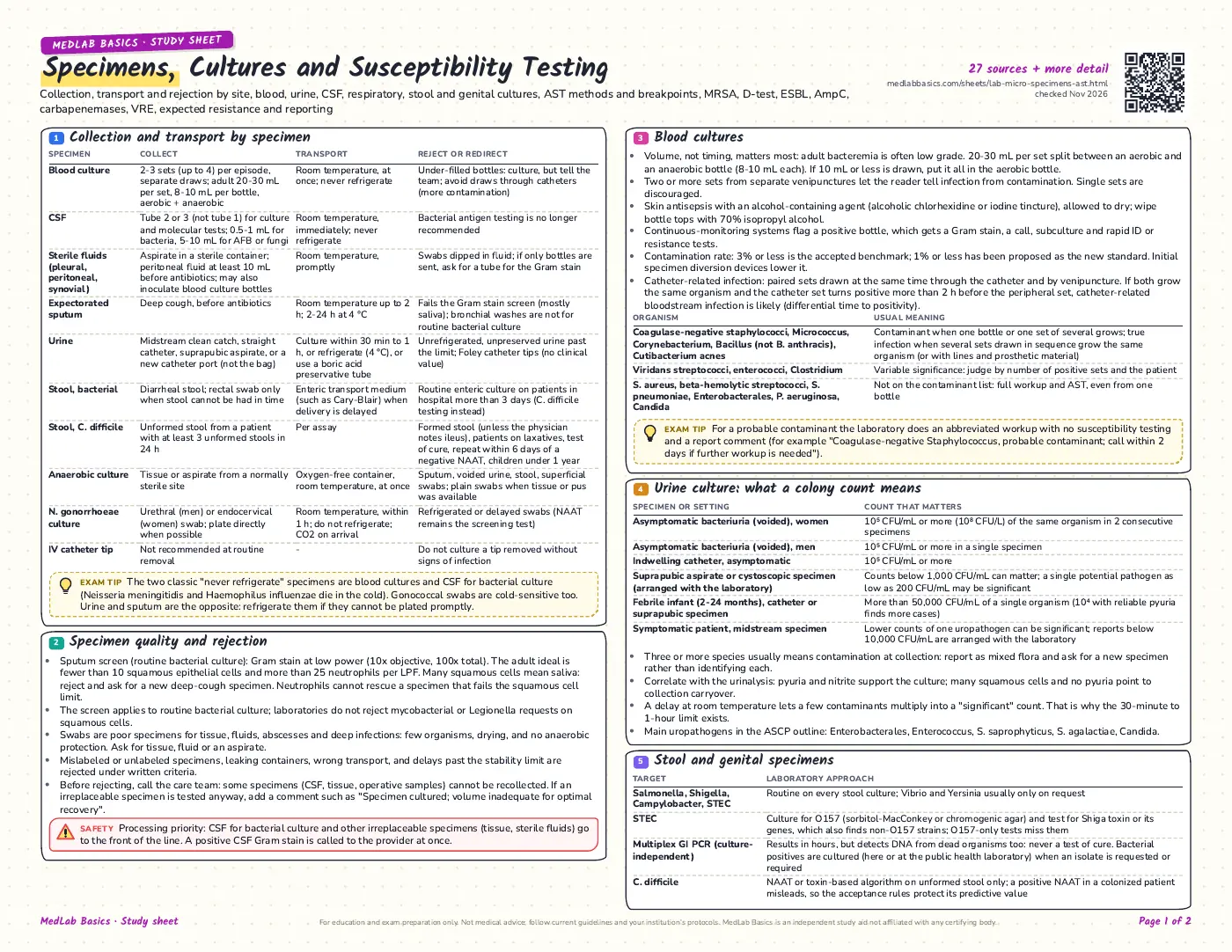
Collection and transport by specimen
| Specimen | Collect | Transport | Reject or redirect |
|---|---|---|---|
| Blood culture | 2-3 sets (up to 4) per episode, separate draws; adult 20-30 mL per set, 8-10 mL per bottle, aerobic + anaerobic | Room temperature, at once; never refrigerate | Under-filled bottles: culture, but tell the team; avoid draws through catheters (more contamination) |
| CSF | Tube 2 or 3 (not tube 1) for culture and molecular tests; 0.5-1 mL for bacteria, 5-10 mL for AFB or fungi | Room temperature, immediately; never refrigerate | Bacterial antigen testing is no longer recommended |
| Sterile fluids (pleural, peritoneal, synovial) | Aspirate in a sterile container; peritoneal fluid at least 10 mL before antibiotics; may also inoculate blood culture bottles | Room temperature, promptly | Swabs dipped in fluid; if only bottles are sent, ask for a tube for the Gram stain |
| Expectorated sputum | Deep cough, before antibiotics | Room temperature up to 2 h; 2-24 h at 4 °C | Fails the Gram stain screen (mostly saliva); bronchial washes are not for routine bacterial culture |
| Urine | Midstream clean catch, straight catheter, suprapubic aspirate, or a new catheter port (not the bag) | Culture within 30 min to 1 h, or refrigerate (4 °C), or use a boric acid preservative tube | Unrefrigerated, unpreserved urine past the limit; Foley catheter tips (no clinical value) |
| Stool, bacterial | Diarrheal stool; rectal swab only when stool cannot be had in time | Enteric transport medium (such as Cary-Blair) when delivery is delayed | Routine enteric culture on patients in hospital more than 3 days (C. difficile testing instead) |
| Stool, C. difficile | Unformed stool from a patient with at least 3 unformed stools in 24 h | Per assay | Formed stool (unless the physician notes ileus), patients on laxatives, test of cure, repeat within 6 days of a negative NAAT, children under 1 year |
| Anaerobic culture | Tissue or aspirate from a normally sterile site | Oxygen-free container, room temperature, at once | Sputum, voided urine, stool, superficial swabs; plain swabs when tissue or pus was available |
| N. gonorrhoeae culture | Urethral (men) or endocervical (women) swab; plate directly when possible | Room temperature, within 1 h; do not refrigerate; CO2 on arrival | Refrigerated or delayed swabs (NAAT remains the screening test) |
| IV catheter tip | Not recommended at routine removal | - | Do not culture a tip removed without signs of infection |
Specimen quality and rejection
- Sputum screen (routine bacterial culture): Gram stain at low power (10x objective, 100x total). The adult ideal is fewer than 10 squamous epithelial cells and more than 25 neutrophils per LPF. Many squamous cells mean saliva: reject and ask for a new deep-cough specimen. Neutrophils cannot rescue a specimen that fails the squamous cell limit.
- The screen applies to routine bacterial culture; laboratories do not reject mycobacterial or Legionella requests on squamous cells.
- Swabs are poor specimens for tissue, fluids, abscesses and deep infections: few organisms, drying, and no anaerobic protection. Ask for tissue, fluid or an aspirate.
- Mislabeled or unlabeled specimens, leaking containers, wrong transport, and delays past the stability limit are rejected under written criteria.
- Before rejecting, call the care team: some specimens (CSF, tissue, operative samples) cannot be recollected. If an irreplaceable specimen is tested anyway, add a comment such as "Specimen cultured; volume inadequate for optimal recovery".
Blood cultures
- Volume, not timing, matters most: adult bacteremia is often low grade. 20-30 mL per set split between an aerobic and an anaerobic bottle (8-10 mL each). If 10 mL or less is drawn, put it all in the aerobic bottle.
- Two or more sets from separate venipunctures let the reader tell infection from contamination. Single sets are discouraged.
- Skin antisepsis with an alcohol-containing agent (alcoholic chlorhexidine or iodine tincture), allowed to dry; wipe bottle tops with 70% isopropyl alcohol.
- Continuous-monitoring systems flag a positive bottle, which gets a Gram stain, a call, subculture and rapid ID or resistance tests.
- Contamination rate: 3% or less is the accepted benchmark; 1% or less has been proposed as the new standard. Initial specimen diversion devices lower it.
- Catheter-related infection: paired sets drawn at the same time through the catheter and by venipuncture. If both grow the same organism and the catheter set turns positive more than 2 h before the peripheral set, catheter-related bloodstream infection is likely (differential time to positivity).
| Organism | Usual meaning |
|---|---|
| Coagulase-negative staphylococci, Micrococcus, Corynebacterium, Bacillus (not B. anthracis), Cutibacterium acnes | Contaminant when one bottle or one set of several grows; true infection when several sets drawn in sequence grow the same organism (or with lines and prosthetic material) |
| Viridans streptococci, enterococci, Clostridium | Variable significance: judge by number of positive sets and the patient |
| S. aureus, beta-hemolytic streptococci, S. pneumoniae, Enterobacterales, P. aeruginosa, Candida | Not on the contaminant list: full workup and AST, even from one bottle |
Urine culture: what a colony count means
| Specimen or setting | Count that matters |
|---|---|
| Asymptomatic bacteriuria (voided), women | 10⁵ CFU/mL or more (10⁸ CFU/L) of the same organism in 2 consecutive specimens |
| Asymptomatic bacteriuria (voided), men | 10⁵ CFU/mL or more in a single specimen |
| Indwelling catheter, asymptomatic | 10⁵ CFU/mL or more |
| Suprapubic aspirate or cystoscopic specimen (arranged with the laboratory) | Counts below 1,000 CFU/mL can matter; a single potential pathogen as low as 200 CFU/mL may be significant |
| Febrile infant (2-24 months), catheter or suprapubic specimen | More than 50,000 CFU/mL of a single organism (10⁴ with reliable pyuria finds more cases) |
| Symptomatic patient, midstream specimen | Lower counts of one uropathogen can be significant; reports below 10,000 CFU/mL are arranged with the laboratory |
- Three or more species usually means contamination at collection: report as mixed flora and ask for a new specimen rather than identifying each.
- Correlate with the urinalysis: pyuria and nitrite support the culture; many squamous cells and no pyuria point to collection carryover.
- A delay at room temperature lets a few contaminants multiply into a "significant" count. That is why the 30-minute to 1-hour limit exists.
- Main uropathogens in the ASCP outline: Enterobacterales, Enterococcus, S. saprophyticus, S. agalactiae, Candida.
Stool and genital specimens
| Target | Laboratory approach |
|---|---|
| Salmonella, Shigella, Campylobacter, STEC | Routine on every stool culture; Vibrio and Yersinia usually only on request |
| STEC | Culture for O157 (sorbitol-MacConkey or chromogenic agar) and test for Shiga toxin or its genes, which also finds non-O157 strains; O157-only tests miss them |
| Multiplex GI PCR (culture-independent) | Results in hours, but detects DNA from dead organisms too: never a test of cure. Bacterial positives are cultured (here or at the public health laboratory) when an isolate is requested or required |
| C. difficile | NAAT or toxin-based algorithm on unformed stool only; a positive NAAT in a colonized patient misleads, so the acceptance rules protect its predictive value |
| N. gonorrhoeae and C. trachomatis | NAAT is the test: vaginal swab (women) and first-void urine (men) are optimal; rectal and pharyngeal swabs too. Culture is needed for susceptibility testing and treatment failure |
| Urethral Gram stain, symptomatic man | Neutrophils with intracellular gram-negative diplococci are diagnostic (sensitivity above 95%, specificity above 99%); not used for endocervical, pharyngeal or rectal specimens |
| Trichomonas vaginalis | NAAT is most sensitive; a saline wet mount (sensitivity roughly 40-80%) must be read within 30 min to 2 h |
| Bacterial vaginosis | Scored Gram stain (or Amsel criteria); culture is not recommended |
| Group B streptococcus, prenatal screen | Vaginal-rectal swab late in pregnancy (about 36-37 weeks) into selective enrichment broth, then subculture or NAAT from the broth; direct plating misses carriers |
Susceptibility testing methods
| Method | Result | Key points |
|---|---|---|
| Broth microdilution (reference) | MIC: the lowest concentration that inhibits visible growth | Twofold dilutions in microtiter wells; read after 16-24 h; automated systems (VITEK 2, Phoenix, MicroScan) are miniaturized broth methods |
| Agar dilution | MIC | Drug in the agar; many isolates per plate; reference method for some organisms |
| Disk diffusion (Kirby-Bauer) | Zone diameter (mm), read against breakpoints | Mueller-Hinton agar 4.0 ± 0.5 mm deep, 0.5 McFarland lawn, 35 °C; larger zone means a lower MIC |
| Gradient strip | MIC read where the ellipse meets the strip | Between two marks, read the higher value; beta-hemolysis can be misread as growth and give a falsely high MIC |
| Category | Meaning |
|---|---|
| S (susceptible) | Likely to respond at the standard dose |
| SDD (susceptible dose-dependent) | Susceptible if exposure is raised by higher or more frequent dosing |
| I (intermediate) | May work where the drug concentrates (such as urine) or at higher doses; also a buffer for technical variation |
| R (resistant) | Not inhibited at achievable concentrations |
| Errors | Very major: a resistant isolate called susceptible (the dangerous one). Major: susceptible called resistant. Minor: involves I |
Detecting resistance
| Resistance | Mechanism | Laboratory test | Report |
|---|---|---|---|
| MRSA (and methicillin-resistant CoNS) | mecA encodes PBP2a, a penicillin-binding protein with low beta-lactam affinity | Cefoxitin 30 µg disk (S. aureus and S. lugdunensis: R ≤ 21, S ≥ 22 mm at 16-18 h; most other staphylococci: R ≤ 24, S ≥ 25 mm at 24 h) or oxacillin MIC (S. aureus and S. lugdunensis R ≥ 4, S ≤ 2; most other staphylococci R ≥ 1, S ≤ 0.5 µg/mL); PBP2a latex; mecA PCR | Oxacillin resistant: resistant to all beta-lactams except the anti-MRSA cephalosporins (ceftaroline, ceftobiprole) |
| Inducible clindamycin resistance | erm methylase alters the ribosome, switched on by a macrolide (inducible MLSB) | D-test: erythromycin 15 µg next to clindamycin 2 µg; flattening of the clindamycin zone toward erythromycin is a D | D positive: report clindamycin resistant. Round zone (efflux, msrA): clindamycin susceptible |
| ESBL | Plasmid enzymes (descended from TEM and SHV, among others) that hydrolyze penicillins, extended-spectrum cephalosporins and aztreonam, not cephamycins; inhibited by clavulanate | Screen: reduced susceptibility to cefotaxime, ceftriaxone, ceftazidime, cefpodoxime or aztreonam. Confirm: ceftazidime and cefotaxime with and without clavulanate; a zone increase of 5 mm or more | With current breakpoints report results as tested; M100 asks the laboratory to agree with stewardship whether ESBL results guide therapy |
| AmpC | Class C cephalosporinase: chromosomal and inducible (Enterobacter, C. freundii, K. aerogenes, Serratia, Morganella, Providencia, Hafnia) or plasmid-borne | Cefoxitin resistance suggests it (not specific); cloxacillin or boronic acid tests; not inhibited by clavulanate | Can mask an ESBL test. Derepressed mutants emerge on third-generation cephalosporins; cefepime is more stable |
| Carbapenemase (CP-CRE) | Serine: KPC (class A), OXA-48-like (class D). Metallo: NDM, VIM, IMP (class B, need zinc) | mCIM (meropenem disk after incubation with the isolate, on an E. coli ATCC 25922 lawn: 6-15 mm positive, ≥ 19 mm negative, 16-18 mm borderline and read by the M100 colony rule); eCIM adds EDTA (≥ 5 mm larger than mCIM = metallo; read only when mCIM is positive); Carba NP; PCR for blaKPC, blaNDM, blaVIM, blaIMP, blaOXA-48 | Infection prevention at once; public health reporting and isolate submission per state rules |
| VRE | vanA: high-level vancomycin and teicoplanin R, transferable. vanB: vancomycin R, teicoplanin S. vanC: low-level, intrinsic in E. gallinarum and E. casseliflavus | MIC or screening agar; chromogenic agar; vanA/vanB PCR (other genera can carry van genes, lowering PPV) | Report the species: vanC is intrinsic to E. gallinarum and E. casseliflavus; follow the infection prevention policy on whether they count as VRE |
Expected (intrinsic) resistance
| Organism | Expected resistant to |
|---|---|
| Klebsiella pneumoniae, K. oxytoca, Citrobacter koseri | Ampicillin (and ticarcillin) |
| Enterobacter cloacae complex, K. aerogenes, Citrobacter freundii | Ampicillin, amoxicillin-clavulanate, ampicillin-sulbactam, cefazolin, cefoxitin (chromosomal AmpC) |
| Serratia marcescens | Ampicillin, amoxicillin-clavulanate, ampicillin-sulbactam, cefazolin, cefoxitin, cefuroxime, colistin, nitrofurantoin |
| Proteus mirabilis | Colistin, nitrofurantoin, tetracyclines |
| Proteus vulgaris, Morganella morganii, Providencia | Ampicillin, cefazolin, colistin, nitrofurantoin, tetracyclines; also cefuroxime (P. vulgaris) and amoxicillin-clavulanate (Morganella, Providencia) |
| All Enterobacterales | Benzylpenicillin, glycopeptides (vancomycin), macrolides (azithromycin aside, used for typhoid), clindamycin, linezolid, rifampin |
| Pseudomonas aeruginosa | Ampicillin, amoxicillin-clavulanate, ampicillin-sulbactam, cefotaxime and ceftriaxone, ertapenem, chloramphenicol, kanamycin, tetracyclines and tigecycline, trimethoprim |
| Acinetobacter baumannii | Ampicillin, amoxicillin-clavulanate, cefotaxime and ceftriaxone, aztreonam, ertapenem, trimethoprim, fosfomycin, tetracycline and doxycycline |
| Stenotrophomonas maltophilia | Carbapenems (imipenem, meropenem), aminoglycosides, trimethoprim alone (usually susceptible to trimethoprim-sulfamethoxazole) |
| Burkholderia cepacia complex | Aminoglycosides, polymyxin B and colistin, many beta-lactams |
| All gram-positive bacteria | Aztreonam, polymyxin B and colistin, nalidixic acid |
| Staphylococcus saprophyticus | Novobiocin, fosfomycin, fusidic acid |
| Enterococcus faecalis | Cephalosporins, clindamycin, quinupristin-dalfopristin, low-level aminoglycosides (synergy still possible) |
| Enterococcus faecium | Cephalosporins, low-level aminoglycosides |
| E. gallinarum, E. casseliflavus | Vancomycin (low level, vanC), cephalosporins, clindamycin |
| Leuconostoc, Pediococcus | Vancomycin and teicoplanin |
| Listeria monocytogenes | Cephalosporins |
In depth
The summary above is what the PDF prints. These sections go further.
Reporting
- Test only clinically significant isolates; contaminants and normal flora do not get AST.
- Cascade reporting: broader agents are suppressed when narrower first-line agents test susceptible (for example meropenem released only if the Enterobacterales isolate is resistant to ceftriaxone and cefepime). Selective reporting suppresses by organism, site or setting (for example aminoglycosides are not reported for Salmonella or Shigella). Rules are set with the stewardship program; antibiograms use all tested results.
- CLSI M100 Table 1 now sorts drugs into Tiers 1-4 (routine, cascade, high-resistance settings, on request) instead of Groups A, B and C; agents for urine isolates only are still marked U.
- Typical critical calls: positive blood culture Gram stain, positive CSF Gram stain or culture, and other organisms on the laboratory critical list. Read back the result and document who was told and when.
- Infection prevention calls: MRSA, VRE, CRE or carbapenemase producers, C. difficile, and other organisms on the facility list. Public health: notifiable organisms (state lists) and isolate submission, including culture of CIDT-positive stools when requested.
- A corrected report (for example a Gram stain misread as cocci that grows yeast) is called to the provider and issued as a documented corrected report.
CSF, sterile fluids and respiratory counts
- CSF: the Gram stain finds organisms in 60-80% of bacterial meningitis before antibiotics and 40-60% after. Draw blood cultures too. Correlate with cell count, glucose and protein (see the Body Fluids page).
- Shunt infections: coagulase-negative staphylococci, Corynebacterium and Cutibacterium are real pathogens here. Shunt or drain parts are cultured only when the patient has signs of CNS infection.
- Pleural fluid in blood culture bottles raises recovery by about 20%, but send a separate tube for the Gram stain and for non-bacterial pathogens.
- Quantitative lower respiratory cultures (ventilated patients): endotracheal aspirate 10⁶ CFU/mL, bronchoalveolar lavage 10⁴ CFU/mL, protected specimen brush 10³ CFU/mL. Above the threshold favors pneumonia; below favors colonization. Report the count, not a yes or no.
Disk diffusion: conditions and what goes wrong
| Condition | Standard (EUCAST manual 2025) | If wrong |
|---|---|---|
| Inoculum | 0.5 McFarland (0.4-0.6), about 1-2 × 10⁸ CFU/mL for E. coli | Too heavy: zones too small (false resistance). Too light: zones too large (false susceptibility) |
| Agar depth | 4.0 ± 0.5 mm (about 25 mL in a 90 mm plate) | Thin agar: zones too large. Thick agar: zones too small |
| Timing (15-15-15 rule) | Use the suspension within 15 min, apply disks within 15 min of inoculating, incubate within 15 min of applying disks | Pre-diffusion or pre-growth distorts zones |
| Incubation | 35 ± 1 °C in air, 18 ± 2 h for most organisms (24 h for glycopeptides on enterococci); streptococci and Haemophilus in 4-6% CO2 on MH-F agar | Short incubation gives unreliable zones; CLSI-based studies read coagulase-negative staphylococci with cefoxitin at 24 h |
| Disks | Sealed with a moisture-indicating desiccant, protected from light, stock and working supply stored as the manufacturer directs, discarded at expiry | Lost potency: zones shrink. Amoxicillin-clavulanate, cefaclor and the carbapenems are among the most labile |
| Reading | Zone edge at complete inhibition; for Proteus ignore swarming | Reading the swarm film as growth overcalls resistance |
| Spacing | Normally at most 6 disks on a 90 mm plate | Overlapping zones cannot be read |
Quality control strains
| Strain | Use |
|---|---|
| Escherichia coli ATCC 25922 | Routine gram-negative QC; also the indicator lawn for mCIM |
| Staphylococcus aureus ATCC 25923 and ATCC 29213 | Oxacillin-susceptible staphylococcal QC (disk and MIC) |
| S. aureus ATCC 43300 | Methicillin-resistant (heteroresistant) control |
| Pseudomonas aeruginosa ATCC 27853 | Gram-negative QC, including routine colistin QC |
| Klebsiella pneumoniae ATCC BAA-1705 / BAA-1706 / BAA-2146 | Carbapenemase controls: KPC positive / negative / NDM positive |
| Streptococcus pneumoniae ATCC 49619, Haemophilus influenzae ATCC 49247 | Fastidious-organism QC |
| Enterococcus faecalis ATCC 51299 | Enterococcal QC listed in M100 |
Worked readings
| Result | Reading |
|---|---|
| S. aureus, cefoxitin 30 µg zone 18 mm | ≤ 21 mm: MRSA. Report oxacillin resistant and all beta-lactams resistant except anti-MRSA cephalosporins |
| S. aureus: erythromycin 10 mm (R), clindamycin 23 mm (S) with a flat side toward erythromycin | D-test positive: report clindamycin resistant with an inducible-resistance comment |
| K. pneumoniae: ceftazidime 15 mm, ceftazidime-clavulanate 23 mm | Increase 8 mm (≥ 5): ESBL confirmed |
| Enterobacter: mCIM 6 mm, eCIM 18 mm | mCIM positive (carbapenemase); eCIM increase 12 mm (≥ 5): metallo-beta-lactamase such as NDM |
| mCIM 6 mm, eCIM 7 mm | Carbapenemase present, not inhibited by EDTA: a serine enzyme such as KPC or OXA-48-like |
| E. gallinarum: vancomycin MIC 8, teicoplanin 0.5 µg/mL | vanC: low-level, intrinsic resistance; report the species (not vanA/vanB VRE) |
| One of four bottles (one set of two) grows coagulase-negative staphylococci at 61 h | Probable contaminant: abbreviated workup, no AST, comment |
Resistance notes the exam likes
- Why cefoxitin for MRSA: it is a very sensitive and specific marker of mecA/mecC resistance, including strains that express it heterogeneously and can show falsely low oxacillin MICs; the oxacillin disk correlates poorly with mecA, so neither EUCAST nor CLSI uses it for S. aureus. Low-level oxacillin-resistant S. aureus without mecA or mecC (borderline, BORSA) is rare; the mechanism may be beta-lactamase hyperproduction or altered native PBPs. mecC strains are missed by mecA PCR and PBP2a latex.
- Staphylococci other than S. aureus and S. lugdunensis: read the cefoxitin disk at 24 h (it may be reported earlier only if resistant). For species outside S. epidermidis, S. pseudintermedius and S. schleiferi the oxacillin MIC can overcall resistance; isolates from serious infections with MICs of 1-2 µg/mL may be checked for mecA or PBP2a.
- D-test spacing differs by standard: EUCAST uses 12-20 mm edge to edge for staphylococci and 12-16 mm for streptococci; flattening is clearest at 15-20 mm and less reliable at 26-28 mm. Constitutive MLSB resistance needs no D-test: the isolate is resistant to both erythromycin and clindamycin on the plate.
- AmpC derepression: Enterobacter, K. aerogenes and C. freundii can turn resistant to cefotaxime, ceftriaxone, ceftazidime and piperacillin-tazobactam during therapy. M100 makes cefepime a Tier 1 drug for these organisms.
- ESBL tests and AmpC: an isolate with high-level AmpC may screen positive for ESBL and fail confirmation, because clavulanate does not inhibit AmpC and may even induce it.
- Beta-lactam combinations: susceptibility to the beta-lactam alone predicts susceptibility to its combination, not the reverse.
- VRE screening: rectal or perianal swab or stool on chromogenic or vancomycin screening agar, or vanA/vanB PCR. A single rectal swab misses many carriers.
- Very major errors (R reported as S) are the error type that QC and method verification are designed to prevent; FDA performance criteria for AST devices cap very major errors (1.5% or less at the lower 95% confidence limit, 7.5% or less at the upper) and major errors (3% or less).
Why the acceptance rules exist
| Rule | Reason |
|---|---|
| Reject sputum full of squamous cells | The culture would grow oral flora and suggest a false pathogen |
| Refrigerate or preserve urine | Contaminants double in a warm specimen and reach "significant" counts |
| Never refrigerate CSF or blood cultures | Meningococci and Haemophilus die in the cold |
| C. difficile: unformed stool, no repeat within 6 days, no test of cure | Many inpatients are colonized; NAAT cannot tell colonization from disease |
| No routine enteric culture after 3 hospital days | Hospital-onset diarrhea is rarely Salmonella, Shigella or Campylobacter |
| Tissue or aspirate over swabs; anaerobic transport | More organisms, protection from oxygen, and the real site of infection |
| No routine IV or Foley catheter tip cultures | Guidelines find no clinical value in routine tip cultures |
| Culture CIDT-positive stools for public health | Isolates are needed for susceptibility, subtyping and outbreak detection |
Practice free in your browser600+ exam-style questions with rationales. Free today, no account, no ads. Pro is coming in January 2027. Also free on Google Play.
Related study sheets
- Gram Stain and Bacterial IdentificationGram stain steps and errors, morphology, primary media, spot tests, identification flowcharts for gram-positive cocci, gram-negative bacilli, fastidious gram-negatives, gram-positive bacilli and anaerobes, MALDI-TOF, and the sentinel lab's rule-out and refer role
- Mycobacteria, Fungi, Parasites and VirusesAFB stains and processing, Runyon groups, Nocardia, yeast and mold identification, dimorphic fungi, the O&P exam, blood parasites, viral specimens and tests, and the biosafety level for each
Sources
- Miller JM, Binnicker MJ, Campbell S, et al. Guide to Utilization of the Microbiology Laboratory for Diagnosis of Infectious Diseases: 2024 Update by IDSA and ASM. Clin Infect Dis. 2024. Link
- Miller JM, Binnicker MJ, Campbell S, et al. A Guide to Utilization of the Microbiology Laboratory for Diagnosis of Infectious Diseases: 2018 Update by IDSA and ASM. Clin Infect Dis. 2018;67:e1-e94. Link
- Baron EJ, Miller JM, Weinstein MP, et al. A Guide to Utilization of the Microbiology Laboratory for Diagnosis of Infectious Diseases: 2013 Recommendations by IDSA and ASM. Clin Infect Dis. 2013;57:e22-e121. Link
- Nicolle LE, Gupta K, Bradley SF, et al. Clinical Practice Guideline for the Management of Asymptomatic Bacteriuria: 2019 Update by IDSA. Clin Infect Dis. 2019;68:e83-e110. Link
- Shane AL, Mody RK, Crump JA, et al. 2017 IDSA Clinical Practice Guidelines for the Diagnosis and Management of Infectious Diarrhea. Clin Infect Dis. 2017;65:e45-e80. Link
- CDC. Sexually Transmitted Infections Treatment Guidelines, 2021: Gonococcal Infections Among Adolescents and Adults. Link
- CDC. About Carbapenem-resistant Enterobacterales (CRE). December 2025. Link
- Doern GV, Carroll KC, Diekema DJ, et al. Practical Guidance for Clinical Microbiology Laboratories: A Comprehensive Update on the Problem of Blood Culture Contamination. Clin Microbiol Rev. 2019;33:e00009-19. Link
- Murdoch DR, Morpeth SC, Hammitt LL, et al. Microscopic Analysis and Quality Assessment of Induced Sputum From Children With Pneumonia in the PERCH Study. Clin Infect Dis. 2017;64(suppl 3):S271-S279. Link
- Schuetz AN, et al. Overview of changes in the Clinical and Laboratory Standards Institute Performance Standards for Antimicrobial Susceptibility Testing (M100, 32nd and 33rd editions). J Clin Microbiol. 2025. Link
- Kuti JL, et al. Point-Counterpoint: Cascade reporting, useful tool to support antimicrobial stewardship, or dangerously misleading. J Clin Microbiol. 2025. Link
- Tsai YM, et al. Combination of modified carbapenem inactivation method (mCIM) and EDTA-CIM (eCIM) for phenotypic detection of carbapenemase-producing Enterobacteriaceae. BMC Microbiol. 2020;20:315. Link
- Gajic I, Kabic J, Kekic D, et al. Antimicrobial Susceptibility Testing: A Comprehensive Review of Currently Used Methods. Antibiotics (Basel). 2022;11:427. Link
- Swenson JM, Tenover FC, et al. Results of disk diffusion testing with cefoxitin correlate with presence of mecA in Staphylococcus spp. J Clin Microbiol. 2005;43:3818-3823. Link
- Naccache SN, Callan K, Burnham CAD, et al. Evaluation of Oxacillin and Cefoxitin Disk Diffusion and Microbroth Dilution Methods for Detecting mecA-Mediated Beta-Lactam Resistance in Contemporary Staphylococcus epidermidis Isolates. J Clin Microbiol. 2019;57:e00961-19. Link
- Fiebelkorn KR, Crawford SA, McElmeel ML, Jorgensen JH. Practical disk diffusion method for detection of inducible clindamycin resistance in Staphylococcus aureus and coagulase-negative staphylococci. J Clin Microbiol. 2003;41:4740-4744. Link
- Mareković I, et al. Vancomycin-Resistant Enterococci: Current Understandings of Resistance in Relation to Transmission and Preventive Strategies. Pathogens. 2024. Link
- Jacoby GA. AmpC beta-lactamases. Clin Microbiol Rev. 2009;22:161-182. Link
- Thomson KS. Controversies about extended-spectrum and AmpC beta-lactamases. Emerg Infect Dis. 2001;7:333-336. Link
- EUCAST. Antimicrobial susceptibility testing: EUCAST disk diffusion method, manual version 13.0. January 2025. Link
- EUCAST. Expected Resistant Phenotypes, version 1.2. January 2023. Link
- EUCAST. Guidelines for detection of resistance mechanisms and specific resistances of clinical and/or epidemiological importance, version 2.0. July 2017. Link
- CLSI. M100 Archived Methods (reflects M100-Ed34, February 2024): tests for detecting methicillin (oxacillin) resistance in Staphylococcus spp. Link
- CDC. Laboratory Testing for Methicillin (oxacillin)-resistant Staphylococcus aureus (MRSA). Updated June 27, 2025. Link
- EUCAST. Expert Rules on Enterobacterales, version 3.3. June 2024. Link
- EUCAST. Expert Rules on Staphylococcus spp. November 2025. Link
- ASCP Board of Certification. Medical Laboratory Scientist MLS(ASCP) Examination Content Guideline. Revised June 9, 2026. Link