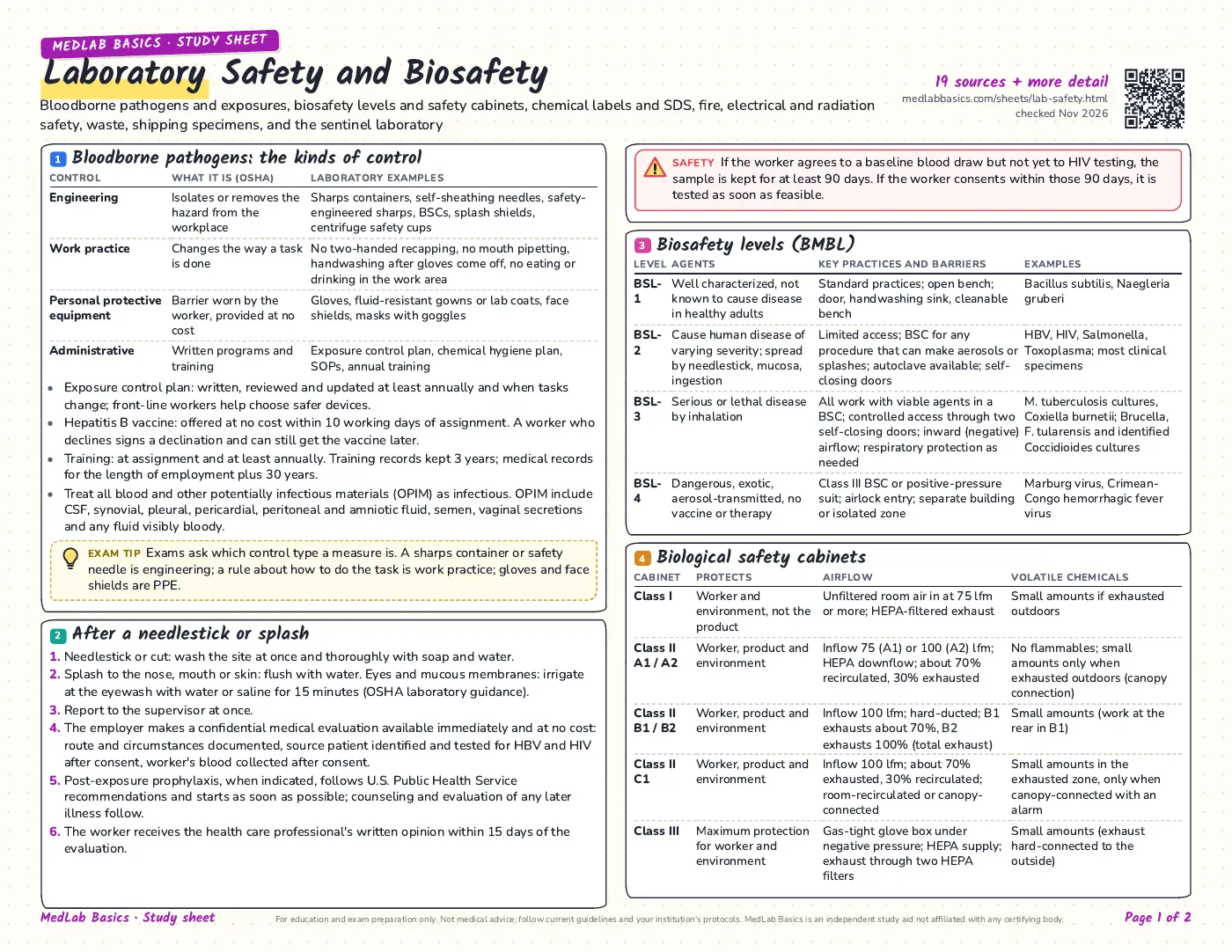
Bloodborne pathogens and exposures, biosafety levels and safety cabinets, chemical labels and SDS, fire, electrical and radiation safety, waste, shipping specimens, and the sentinel laboratory
No two-handed recapping, no mouth pipetting, handwashing after gloves come off, no eating or drinking in the work area
Personal protective equipment
Barrier worn by the worker, provided at no cost
Gloves, fluid-resistant gowns or lab coats, face shields, masks with goggles
Administrative
Written programs and training
Exposure control plan, chemical hygiene plan, SOPs, annual training
Exposure control plan: written, reviewed and updated at least annually and when tasks change; front-line workers help choose safer devices.
Hepatitis B vaccine: offered at no cost within 10 working days of assignment. A worker who declines signs a declination and can still get the vaccine later.
Training: at assignment and at least annually. Training records kept 3 years; medical records for the length of employment plus 30 years.
Treat all blood and other potentially infectious materials (OPIM) as infectious. OPIM include CSF, synovial, pleural, pericardial, peritoneal and amniotic fluid, semen, vaginal secretions and any fluid visibly bloody.
After a needlestick or splash
Needlestick or cut: wash the site at once and thoroughly with soap and water.
Splash to the nose, mouth or skin: flush with water. Eyes and mucous membranes: irrigate at the eyewash with water or saline for 15 minutes (OSHA laboratory guidance).
Report to the supervisor at once.
The employer makes a confidential medical evaluation available immediately and at no cost: route and circumstances documented, source patient identified and tested for HBV and HIV after consent, worker's blood collected after consent.
Post-exposure prophylaxis, when indicated, follows U.S. Public Health Service recommendations and starts as soon as possible; counseling and evaluation of any later illness follow.
The worker receives the health care professional's written opinion within 15 days of the evaluation.
Biosafety levels (BMBL)
Level
Agents
Key practices and barriers
Examples
BSL-1
Well characterized, not known to cause disease in healthy adults
Standard practices; open bench; door, handwashing sink, cleanable bench
Bacillus subtilis, Naegleria gruberi
BSL-2
Cause human disease of varying severity; spread by needlestick, mucosa, ingestion
Limited access; BSC for any procedure that can make aerosols or splashes; autoclave available; self-closing doors
HBV, HIV, Salmonella, Toxoplasma; most clinical specimens
BSL-3
Serious or lethal disease by inhalation
All work with viable agents in a BSC; controlled access through two self-closing doors; inward (negative) airflow; respiratory protection as needed
M. tuberculosis cultures, Coxiella burnetii; Brucella, F. tularensis and identified Coccidioides cultures
BSL-4
Dangerous, exotic, aerosol-transmitted, no vaccine or therapy
Class III BSC or positive-pressure suit; airlock entry; separate building or isolated zone
Inflow 100 lfm; about 70% exhausted, 30% recirculated; room-recirculated or canopy-connected
Small amounts in the exhausted zone, only when canopy-connected with an alarm
Class III
Maximum protection for worker and environment
Gas-tight glove box under negative pressure; HEPA supply; exhaust through two HEPA filters
Small amounts (exhaust hard-connected to the outside)
Certify BSCs at least annually and whenever moved. No open flames in a BSC; use an electric loop sterilizer or disposable loops.
UV lamps are never the only disinfection method, and they are off when the room is occupied.
Use a BSC for pipetting, centrifuging, grinding, blending, shaking, mixing, sonicating and opening containers of infectious material. Wait 10 minutes after the rotor stops before opening a centrifuge used for infectious material.
Product, supplier, hazard class and category, signal word, pictograms, ingredients
4 First-aid measures
What to do for eye, skin, inhalation and ingestion exposure
5 Fire-fighting measures
Extinguishing media, combustion hazards
6 Accidental release measures
Spill containment and cleanup
7 Handling and storage · 8 Exposure controls/PPE
Incompatibles and storage; exposure limits, ventilation, gloves, respirators
9-11 Properties, stability and reactivity, toxicology
Flash point, reactivity, health effects
12-15 Ecological, disposal, transport, regulatory
Headings kept for GHS order; content not mandatory under OSHA
16 Other information
Date of preparation or last revision
A shipped container label carries six things: product identifier, signal word ('Danger' for severe, 'Warning' for less severe), hazard statements, pictograms, precautionary statements, and the responsible party's name, address and phone.
SDSs must be readily accessible to workers on every shift; electronic access is acceptable if nothing blocks immediate access.
Fire
Step
RACE (response)
PASS (extinguisher)
1
Rescue anyone in danger
Pull the pin
2
Activate the alarm
Aim low at the base of the fire
3
Confine the fire by closing doors
Squeeze the handle, extinguisher upright
4
Evacuate, or Extinguish if small
Sweep side to side at the base
Class
Fuel
Laboratory example
A
Ordinary combustibles
Paper, cloth, wood, many plastics
B
Flammable liquids and gases, grease
Solvents (xylene, alcohols), flammable gases
C
Energized electrical equipment
Analyzer, wiring, computer
D
Combustible metals
Magnesium, sodium, potassium
K
Cooking oils and fats
Kitchens, not usually the lab
Shipping specimens and cultures
Category
What it is
UN number and name
Packaging
Category A
Can cause permanent disability or life-threatening or fatal disease in healthy people or animals on exposure
UN2814 (affecting humans), UN2900 (animals only), UN3549 (solid medical waste)
Triple packaging tested to the Category A standard (UN specification mark), itemized contents list
Category B
Infectious, but not in a form that meets Category A
UN3373 'Biological substance, Category B'
Triple packaging; UN3373 diamond mark; 1.2 m drop test
Exempt specimen
Routine testing not related to infectious disease, low probability of pathogens (for example cholesterol, glucose, drug tests)
None
US ground (49 CFR): excepted from Division 6.2 rules. WHO and air rules: basic triple packaging marked 'Exempt human specimen'
Regulated medical waste
Waste from patient care or testing
UN3291
Leakproof; sharps in puncture-resistant containers
Sentinel laboratories (LRN)
Sentinel laboratories in the Laboratory Response Network provide routine diagnostic services, rule out and refer: when an isolate cannot be ruled out as a threat agent (such as Bacillus anthracis, Brucella, Francisella tularensis or Yersinia pestis), further work moves into the BSC and the isolate goes to an LRN reference laboratory, such as the state public health laboratory. National laboratories such as CDC do the specialized characterization.
In depth
The summary above is what the PDF prints. These sections go further.
The bloodborne pathogens standard in detail
Topic
What 29 CFR 1910.1030 requires
Exposure incident
Eye, mouth, other mucous membrane, non-intact skin or parenteral contact with blood or OPIM during work
OPIM
Semen, vaginal secretions, CSF, synovial, pleural, pericardial, peritoneal and amniotic fluid, saliva in dental work, any visibly bloody fluid, fluids that cannot be told apart, unfixed human tissue, HIV- or HBV-containing cultures
Needles and sharps
Contaminated needles are not bent, recapped or removed unless no alternative exists, and then only one-handed or with a device; never sheared or broken
Sharps containers
Closable, puncture resistant, leakproof on sides and bottom, labeled or color-coded; upright, easily reached, replaced before they overfill
Broken glass
Never picked up by hand; use a brush and dustpan, tongs or forceps
Hands
Washed immediately or as soon as feasible after removing gloves or other PPE
Work area
No eating, drinking, smoking, cosmetics, lip balm or contact lens handling; no food in refrigerators or on benches where blood is kept; no mouth pipetting
PPE
Provided, cleaned, repaired and replaced at no cost; removed before leaving the work area; masks with eye protection or chin-length face shields whenever splashes or droplets can reach eyes, nose or mouth
Surfaces
Decontaminated after any spill and at the end of the shift if they may have been contaminated
Labels
Biohazard symbol, fluorescent orange or orange-red; red bags or containers may replace labels
Regulated waste
Liquid or semi-liquid blood or OPIM, items that would release it if compressed, items caked with dried blood, contaminated sharps, pathological and microbiological waste
Sharps injury log
Device type and brand, work area and how the injury happened, kept confidential
OSHA's term is Universal Precautions: all human blood and certain body fluids are treated as if known to carry HIV, HBV and other bloodborne pathogens. In a laboratory this means every specimen, because the source is rarely known. BMBL places work with human blood, body fluids, tissues and primary cell lines at BSL-2 and points to the bloodborne pathogens standard for the specific precautions.
Risk assessment, aerosols and specific agents
Biosafety starts with a risk assessment of the agent and the procedure. BMBL notes that an agent's risk group does not by itself fix the laboratory level. The WHO Laboratory Biosafety Manual (4th edition, 2020) organizes controls by assessed risk rather than by fixed level: core requirements for all laboratories, heightened control measures when the assessed risk stays too high, and maximum containment measures for the highest-risk work.
Agent or situation
BMBL recommendation
Mycobacterium tuberculosis complex
Clinical specimens treated as infectious (infective dose under 10 bacilli); BSL-3 for propagating and manipulating cultures; fix slides on a warming tray, not in a flame; bacilli can survive heat fixing
Brucella species
BSL-3 for all culture work and for specimens suspected to contain Brucella; BSL-2 for routine clinical specimens; infections have followed sniffing cultures and open-bench work
Francisella tularensis
BSL-3 for all work with suspect cultures, including setting up automated identification
Coccidioides species
BSL-3 for sporulating mold cultures once identified; never make a slide culture from an unknown hyaline mold
Blastomyces dermatitidis
BSL-3 for identified sporulating mold-form cultures; BSL-2 for clinical material and yeast-form cultures
An unknown white, cottony mold from a respiratory specimen, especially from an endemic area, stays closed (taped plate) and is opened only in a BSC.
Centrifuges: use safety buckets or sealed rotors when available, check the sealing rings, balance the load, load and unload the cups in the BSC, and decontaminate at once after a breakage.
Clinical laboratories keep work surfaces wiped with a disinfectant active against the agent, left on for its contact time. Spills of infectious material are cleaned by trained staff following a posted spill procedure.
HEPA filters remove at least 99.99% of particles at the most penetrating size (about 0.3 µm). They do not capture chemical vapors or gases.
Chemical safety: Hazard Communication and the Laboratory Standard
Skin corrosion or burns, eye damage, corrosive to metals
Exploding bomb
Explosives, self-reactives, organic peroxides
Flame over circle
Oxidizers
Skull and crossbones
Acute toxicity (fatal or toxic)
Environment (not mandatory under OSHA)
Aquatic toxicity
Each pictogram is a black symbol on a white background inside a red square set on its point, and each appears only once on a label. NFPA 704 is a different system for emergency responders: it rates acute hazards only, while HazCom labels cover acute and chronic hazards for workers. OSHA warns against copying SDS hazard category numbers onto the NFPA diamond.
Laboratory Standard (29 CFR 1910.1450)
Requirement
Chemical hygiene plan
Written procedures, equipment, PPE and work practices that protect workers from the chemicals in that laboratory; reviewed at least annually
Plan contents
SOPs, criteria for exposure controls, fume hood performance checks, training, when prior approval is needed, medical consultation, a chemical hygiene officer, extra protection for select carcinogens, reproductive toxins and highly toxic substances
Chemical hygiene officer
Employee qualified by training or experience who guides development and use of the plan
Medical consultation or examination
Offered when a worker has symptoms of exposure, when monitoring routinely exceeds the action level (or PEL), and after a spill, leak or explosion likely to have caused a hazardous exposure; free, without loss of pay, by or under a licensed physician
Exposure monitoring
When there is reason to believe exposure exceeds the action level or PEL; workers told of results within 15 working days
Eyewash and drench shower: facilities for quick drenching or flushing of the eyes and body are required within the work area, for immediate emergency use, wherever eyes or body can be exposed to injurious corrosive materials.
Fume hood vs BSC: use a chemical fume hood for volatile chemicals when biological containment is not needed. A BSC's HEPA filter does not stop vapors, and its electrical parts are not spark-proof.
Formaldehyde: OSHA's permissible exposure limit is 0.75 ppm as an 8-hour time-weighted average.
Chemical waste: collected at or near where it is made, in compatible, labeled containers kept closed; incompatibles kept apart; never evaporated in a hood.
Compressed gases: inert gases such as nitrogen can displace oxygen; a cylinder with a broken valve can become a projectile, so cylinders are secured and listed in the chemical inventory.
Cryogens and dry ice: liquid nitrogen boils at -196 °C and dry ice sublimes at -78 °C. Hazards are cold burns and asphyxiation from oxygen displacement.
Fire, electrical, radiation and ergonomics
OSHA calls fire the most common serious hazard in a typical laboratory. During a fire, put infectious materials in an autoclave, incubator, refrigerator or freezer if it is safe to do so.
Extinguishers are placed so that no one travels more than 75 ft (22.9 m) to one for Class A hazards or 50 ft (15.2 m) for Class B hazards; they are checked monthly and maintained yearly, and designated users are trained at least annually.
RACE wording varies between hospitals (the last step is written Extinguish, Evacuate or both). Clothing fire: stop, drop and roll, or use a fire blanket or safety shower when no chemicals or electricity are involved.
Electrical: remove from service equipment with frayed cords, damaged enclosures or a missing ground prong; do not plug or unplug equipment with wet hands; GFCIs on 120 V receptacles; outlets inside a BSC are GFCI-protected. Servicing equipment requires lockout/tagout.
Radiation: users of radioactive isotopes must be licensed by the NRC or an Agreement State. Exposures are kept as low as reasonably achievable (ALARA), applied through time, distance and shielding. The adult occupational limit is 5 rem (0.05 Sv) a year; areas are posted with the radiation symbol and access is restricted.
Ergonomics: repetitive pipetting, sorting and computer work and static posture cause musculoskeletal disorders. Controls include ergonomic pipettes and microscopes, arm supports, adjustable workstations, anti-fatigue mats, task rotation and devices for lifting full carboys.
Latex allergy: latex-free gloves, liners or powder-free alternatives must be readily available to allergic workers.
Rigid, puncture-resistant, leakproof, labeled sharps container; replaced before full
Biohazard (regulated) waste
Red or biohazard-labeled bags or containers; decontaminated, usually by autoclave, or incinerated
Cultures and stocks
Decontaminated before disposal by a verified method
Chemical waste
Compatible, labeled, closed containers; segregated by compatibility; handled through the safety office; never evaporated in the hood
Radioactive waste
Handled under the radiation license
A steam cycle for clean items can be 20 minutes at 121 °C, but loads of infectious waste need longer cycles that are validated for the typical load with thermocouples and biological indicators, then verified by monitoring each run (time, temperature, pressure) and periodic biological indicators.
Packaging and transport in detail
Assignment to Category A is based on the patient's history or symptoms, endemic local conditions or professional judgment. 49 CFR defines a culture as a pathogen intentionally propagated and keeps it separate from patient specimens (including specimens in transport media and blood culture bottles).
Category B (49 CFR 173.199): primary receptacles packed so they cannot break or leak into the secondary; secondary packaging cushioned inside a rigid outer packaging; at least one outer surface 100 mm by 100 mm; UN3373 square-on-point mark with sides of at least 50 mm and the name 'Biological substances, Category B' beside it; a name and phone number of a knowledgeable person on the paperwork or package.
Liquids by air: primary or secondary packaging withstands a 95 kPa pressure difference; no more than 1 L per primary receptacle and 4 L per outer package (refrigerant not counted). Solids by air: no more than 4 kg per outer package.
Category A packaging also withstands 95 kPa and -40 °C to +55 °C, has an itemized contents list between the secondary and outer packaging, and screw caps secured with tape or another positive means.
Dry ice: outside the secondary packaging, interior supports keep the secondary in place as the ice sublimes, the box lets CO₂ escape, and the package is marked 'Dry ice' or 'Carbon dioxide, solid'.
Every person who prepares or ships Category B packages must know these requirements. U.S. ground rules (49 CFR) and air rules differ in detail: 49 CFR excepts samples sent for routine testing unrelated to infectious disease, and WHO describes these as exempt specimens that still need three layers of packaging.
Received packages are inspected; a broken or leaking package is placed in a sealable container, the outside decontaminated, and handled by trained staff.
Select agents and the Laboratory Response Network
LRN level
Role
Sentinel
Routine diagnostic services, rule-out and referral; decide which isolates go to a reference laboratory
Reference
Investigation or referral of specimens with LRN reagents and protocols; test high-risk clinical and environmental samples; train sentinel laboratories
National
Specialized characterization, bioforensics, select agent work and highly infectious agents (for example CDC)
The federal select agent list (42 CFR 73.3 and 73.4) includes Bacillus anthracis, Francisella tularensis, Yersinia pestis, Burkholderia mallei and pseudomallei, Coxiella burnetii, botulinum neurotoxins, Ebola, Marburg and variola viruses, among others. Brucella species are no longer on the list but remain BSL-3 culture agents that sentinel laboratories rule out and refer.
A clinical laboratory that identifies a select agent in a diagnostic specimen is exempt from the select agent rules for that specimen only if it reports the identification to CDC or APHIS and the specimen provider, submits APHIS/CDC Form 4 within 7 calendar days, secures the agent, and transfers or destroys it within 7 calendar days (30 days for botulinum neurotoxin and staphylococcal enterotoxins).
Identification of Bacillus anthracis, Bacillus cereus biovar anthracis, Burkholderia mallei or pseudomallei, botulinum neurotoxins or toxin-producing Clostridium, Ebola, Marburg, variola viruses, F. tularensis or Y. pestis is reported immediately by phone, fax or email, then Form 4 within 7 days (42 CFR 73.5 and 73.6).
Occupational Safety and Health Administration. 29 CFR 1910.1030, Bloodborne pathogens. Link
Occupational Safety and Health Administration. 29 CFR 1910.1450, Occupational exposure to hazardous chemicals in laboratories (with Appendix A). Link
Occupational Safety and Health Administration. 29 CFR 1910.1200, Hazard Communication (paragraphs (f) and (g), Appendix C). Link
Occupational Safety and Health Administration. 29 CFR 1910.155 and 1910.157, Fire protection definitions and portable fire extinguishers; 29 CFR 1910.151(c), eyewash and drench facilities. Link
Occupational Safety and Health Administration. Laboratory Safety Guidance (OSHA 3404-11R). 2011. Link
Occupational Safety and Health Administration. QuickCard: Hazard Communication Standard Pictogram (OSHA 3491-08R, 2024). Link
Occupational Safety and Health Administration. QuickCard: Comparison of NFPA 704 and HazCom 2012 Labels (OSHA 3678). Link
Occupational Safety and Health Administration. eTool: Portable Fire Extinguishers, Extinguisher Basics and Fire Extinguisher Use. Link
Occupational Safety and Health Administration. Hospital eTool: Laboratory, Work-related Musculoskeletal Disorders; Hospital-wide Hazards, Electrical Safety. Link
Centers for Disease Control and Prevention, National Institutes of Health. Biosafety in Microbiological and Biomedical Laboratories, 6th edition. 2020 (Sections III and IV, Appendices A and B, agent summaries). Link
World Health Organization. Laboratory Biosafety Manual, 4th edition. Geneva: WHO; 2020. Link
Code of Federal Regulations, Title 49, Section 173.134: Division 6.2 definitions and exceptions (Category A and B, UN numbers, patient specimens). Link
Code of Federal Regulations, Title 49, Section 173.196: Category A infectious substances (packaging). Link
Code of Federal Regulations, Title 49, Section 173.199: Category B infectious substances (triple packaging, UN3373). Link
Code of Federal Regulations, Title 42, Part 73 (73.3 HHS select agents, 73.4 overlap select agents, 73.5 and 73.6 exemptions and reporting); 9 CFR 121.3 and 121.4. Link
U.S. Nuclear Regulatory Commission. 10 CFR 20.1003 (ALARA) and 20.1201 (occupational dose limits for adults). Link
Centers for Disease Control and Prevention. The Laboratory Response Network: biological laboratories (sentinel, reference, national). Link
Centers for Disease Control and Prevention. Best Practices for Occupational Exposure to Blood. Link
Centers for Disease Control and Prevention. Bloodborne Pathogens Exposure Job Aid (course: Fundamentals of Bloodborne Pathogens). Link
 MedLab Basics