 MedLab Basics
Exam guide
ASCP MLS Exam Guide
The Medical Laboratory Scientist exam: format, content areas, eligibility, renewal and a 6-week study plan
Practice ASCP MLS questions free
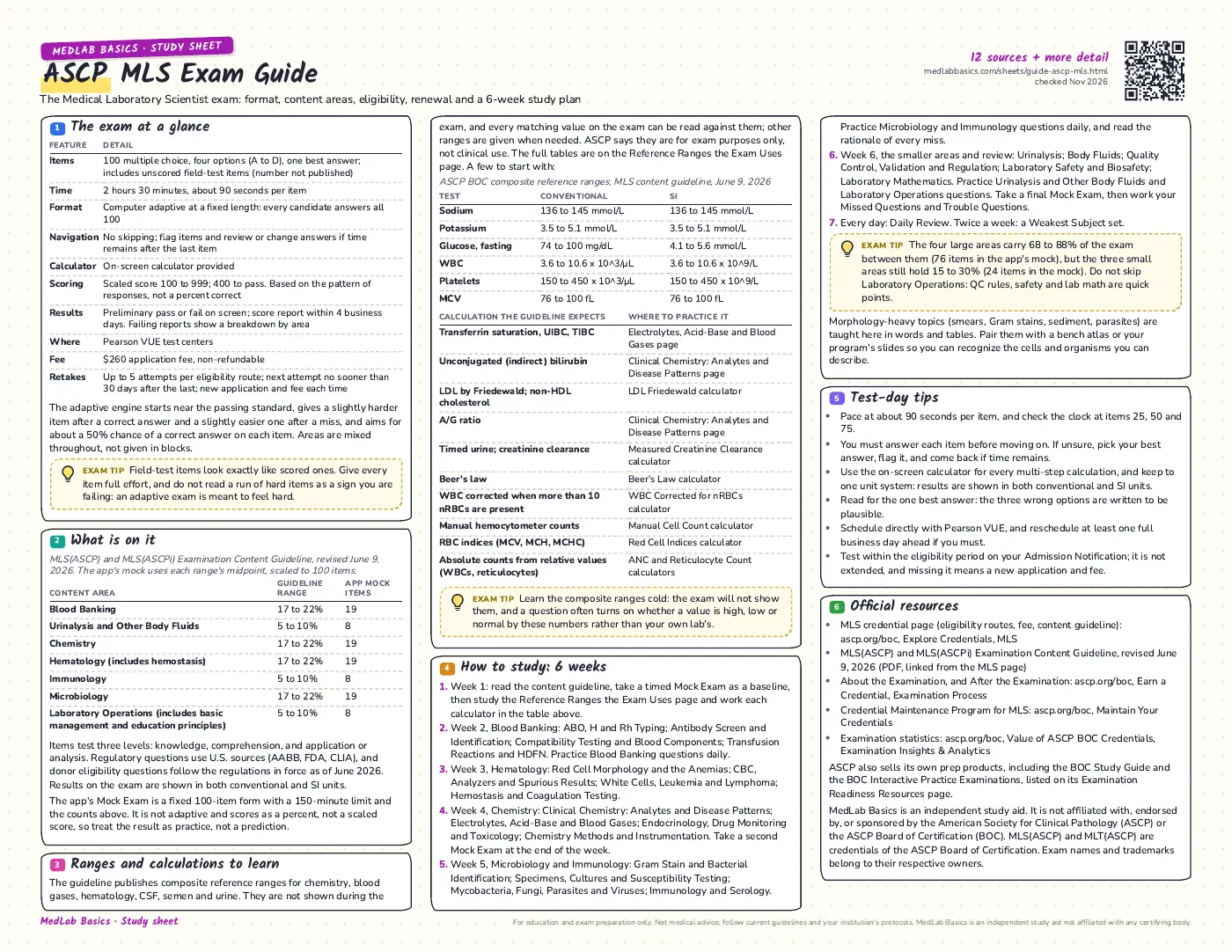
The exam at a glance
| Feature | Detail |
|---|---|
| Items | 100 multiple choice, four options (A to D), one best answer; includes unscored field-test items (number not published) |
| Time | 2 hours 30 minutes, about 90 seconds per item |
| Format | Computer adaptive at a fixed length: every candidate answers all 100 |
| Navigation | No skipping; flag items and review or change answers if time remains after the last item |
| Calculator | On-screen calculator provided |
| Scoring | Scaled score 100 to 999; 400 to pass. Based on the pattern of responses, not a percent correct |
| Results | Preliminary pass or fail on screen; score report within 4 business days. Failing reports show a breakdown by area |
| Where | Pearson VUE test centers |
| Fee | $260 application fee, non-refundable |
| Retakes | Up to 5 attempts per eligibility route; next attempt no sooner than 30 days after the last; new application and fee each time |
The adaptive engine starts near the passing standard, gives a slightly harder item after a correct answer and a slightly easier one after a miss, and aims for about a 50% chance of a correct answer on each item. Areas are mixed throughout, not given in blocks.
What is on it
| Content area | Guideline range | App mock items |
|---|---|---|
| Blood Banking | 17 to 22% | 19 |
| Urinalysis and Other Body Fluids | 5 to 10% | 8 |
| Chemistry | 17 to 22% | 19 |
| Hematology (includes hemostasis) | 17 to 22% | 19 |
| Immunology | 5 to 10% | 8 |
| Microbiology | 17 to 22% | 19 |
| Laboratory Operations (includes basic management and education principles) | 5 to 10% | 8 |
Items test three levels: knowledge, comprehension, and application or analysis. Regulatory questions use U.S. sources (AABB, FDA, CLIA), and donor eligibility questions follow the regulations in force as of June 2026. Results on the exam are shown in both conventional and SI units.
The app's Mock Exam is a fixed 100-item form with a 150-minute limit and the counts above. It is not adaptive and scores as a percent, not a scaled score, so treat the result as practice, not a prediction.
Ranges and calculations to learn
The guideline publishes composite reference ranges for chemistry, blood gases, hematology, CSF, semen and urine. They are not shown during the exam, and every matching value on the exam can be read against them; other ranges are given when needed. ASCP says they are for exam purposes only, not clinical use. The full tables are on the Reference Ranges the Exam Uses page. A few to start with:
| Test | Conventional | SI |
|---|---|---|
| Sodium | 136 to 145 mmol/L | 136 to 145 mmol/L |
| Potassium | 3.5 to 5.1 mmol/L | 3.5 to 5.1 mmol/L |
| Glucose, fasting | 74 to 100 mg/dL | 4.1 to 5.6 mmol/L |
| WBC | 3.6 to 10.6 x 10^3/µL | 3.6 to 10.6 x 10^9/L |
| Platelets | 150 to 450 x 10^3/µL | 150 to 450 x 10^9/L |
| MCV | 76 to 100 fL | 76 to 100 fL |
| Calculation the guideline expects | Where to practice it |
|---|---|
| Transferrin saturation, UIBC, TIBC | Electrolytes, Acid-Base and Blood Gases page |
| Unconjugated (indirect) bilirubin | Clinical Chemistry: Analytes and Disease Patterns page |
| LDL by Friedewald; non-HDL cholesterol | LDL Friedewald calculator |
| A/G ratio | Clinical Chemistry: Analytes and Disease Patterns page |
| Timed urine; creatinine clearance | Measured Creatinine Clearance calculator |
| Beer's law | Beer's Law calculator |
| WBC corrected when more than 10 nRBCs are present | WBC Corrected for nRBCs calculator |
| Manual hemocytometer counts | Manual Cell Count calculator |
| RBC indices (MCV, MCH, MCHC) | Red Cell Indices calculator |
| Absolute counts from relative values (WBCs, reticulocytes) | ANC and Reticulocyte Count calculators |
How to study: 6 weeks
- Week 1: read the content guideline, take a timed Mock Exam as a baseline, then study the Reference Ranges the Exam Uses page and work each calculator in the table above.
- Week 2, Blood Banking: ABO, H and Rh Typing; Antibody Screen and Identification; Compatibility Testing and Blood Components; Transfusion Reactions and HDFN. Practice Blood Banking questions daily.
- Week 3, Hematology: Red Cell Morphology and the Anemias; CBC, Analyzers and Spurious Results; White Cells, Leukemia and Lymphoma; Hemostasis and Coagulation Testing.
- Week 4, Chemistry: Clinical Chemistry: Analytes and Disease Patterns; Electrolytes, Acid-Base and Blood Gases; Endocrinology, Drug Monitoring and Toxicology; Chemistry Methods and Instrumentation. Take a second Mock Exam at the end of the week.
- Week 5, Microbiology and Immunology: Gram Stain and Bacterial Identification; Specimens, Cultures and Susceptibility Testing; Mycobacteria, Fungi, Parasites and Viruses; Immunology and Serology. Practice Microbiology and Immunology questions daily, and read the rationale of every miss.
- Week 6, the smaller areas and review: Urinalysis; Body Fluids; Quality Control, Validation and Regulation; Laboratory Safety and Biosafety; Laboratory Mathematics. Practice Urinalysis and Other Body Fluids and Laboratory Operations questions. Take a final Mock Exam, then work your Missed Questions and Trouble Questions.
- Every day: Daily Review. Twice a week: a Weakest Subject set.
Morphology-heavy topics (smears, Gram stains, sediment, parasites) are taught here in words and tables. Pair them with a bench atlas or your program's slides so you can recognize the cells and organisms you can describe.
Test-day tips
- Pace at about 90 seconds per item, and check the clock at items 25, 50 and 75.
- You must answer each item before moving on. If unsure, pick your best answer, flag it, and come back if time remains.
- Use the on-screen calculator for every multi-step calculation, and keep to one unit system: results are shown in both conventional and SI units.
- Read for the one best answer: the three wrong options are written to be plausible.
- Schedule directly with Pearson VUE, and reschedule at least one full business day ahead if you must.
- Test within the eligibility period on your Admission Notification; it is not extended, and missing it means a new application and fee.
Official resources
- MLS credential page (eligibility routes, fee, content guideline): ascp.org/boc, Explore Credentials, MLS
- MLS(ASCP) and MLS(ASCPi) Examination Content Guideline, revised June 9, 2026 (PDF, linked from the MLS page)
- About the Examination, and After the Examination: ascp.org/boc, Earn a Credential, Examination Process
- Credential Maintenance Program for MLS: ascp.org/boc, Maintain Your Credentials
- Examination statistics: ascp.org/boc, Value of ASCP BOC Credentials, Examination Insights & Analytics
ASCP also sells its own prep products, including the BOC Study Guide and the BOC Interactive Practice Examinations, listed on its Examination Readiness Resources page.
MedLab Basics is an independent study aid. It is not affiliated with, endorsed by, or sponsored by the American Society for Clinical Pathology (ASCP) or the ASCP Board of Certification (BOC). MLS(ASCP) and MLT(ASCP) are credentials of the ASCP Board of Certification. Exam names and trademarks belong to their respective owners.
In depth
The summary above is what the PDF prints. These sections go further.
Eligibility routes for MLS(ASCP)
| Route | Requirements |
|---|---|
| 1 | Bachelor's degree plus a NAACLS-accredited MLS program completed within the last 5 years |
| 2 | Valid MLT(ASCP), a bachelor's degree with 16 semester hours of biology (one semester of microbiology) and 16 of chemistry (one semester of organic chemistry or biochemistry), and 2 years of full-time clinical experience within the last 5 years |
| 3 | Discontinued January 1, 2023 |
| 4 | Bachelor's degree with the same science hours plus 5 years of full-time clinical experience within the last 10 years |
| 5 | Valid MLS(ASCPi), a U.S.-equivalent bachelor's degree, and 5 years of experience within the last 10 years; no re-examination |
| 6 | A 50-week U.S. military medical laboratory course within the last 10 years, a bachelor's degree with the science hours, and 1 year of experience |
- Experience for Routes 2, 4 and 5 must be in an acceptable laboratory (CMS CLIA, DoD CLIP, JCI or ISO 15189) and must cover blood bank, chemistry, hematology, microbiology, immunology, and urinalysis and body fluids.
- Completing an accredited MLS or MLT program, or a foreign MLS clinical program, within 5 years can replace 1 year of the experience.
- Students in accredited programs should apply no more than 6 weeks before they complete the program.
- MLS(ASCPi) candidates take the same content guideline; international routes are listed on the ASCPi tab of the MLS page.
Results, retakes and renewal
- Score review: $25, requested within 30 days. ASCP does not rescore or release items.
- After five failed attempts under one route, a candidate must qualify under another route.
- The credential is time-limited to 3 years. Renew through the Credential Maintenance Program (CMP): 36 points per 3-year cycle.
- CMP points: 2 each in blood banking, chemistry, hematology and microbiology; 1 in laboratory or patient safety; 1 in medical ethics; 26 in the specialty or related areas.
- CMP fee: $110. Reinstating an expired credential adds a $135 fee.
- With CMP the credential is written MLS(ASCP) with a superscript CM.
- From January 2026, new credentials come with a digital badge; wall certificates are no longer issued.
2025 pass rates
| MLS(ASCP), calendar year 2025 | Pass rate | Passed of exams taken |
|---|---|---|
| All attempts | 69% | 4,065 of 5,873 |
| First-time | 77% | 3,554 of 4,638 |
| Repeat | 42% | 512 of 1,233 |
| Accredited (NAACLS) MLS program graduates, Route 1 | 72% | 5,159 exams taken |
The gap between first-time and repeat pass rates is the strongest argument for preparing fully before the first attempt.
Sources
- ASCP Board of Certification. MLS(ASCP) and MLS(ASCPi) Examination Content Guideline, revised June 9, 2026 (PDF, 17 pages). Link
- ASCP Board of Certification. Medical Laboratory Scientist, MLS(ASCP) and MLS(ASCPi): eligibility routes and fees. Accessed November 15, 2026. Link
- ASCP Board of Certification. About the Examination. Accessed November 15, 2026. Link
- ASCP Board of Certification. Examination Results. Accessed November 15, 2026. Link
- ASCP Board of Certification. After the Examination. Accessed November 15, 2026. Link
- ASCP Board of Certification. Application Policies. Accessed November 15, 2026. Link
- ASCP Board of Certification. Schedule or Reschedule Your Examination. Accessed November 15, 2026. Link
- ASCP Board of Certification. Credential Maintenance Program requirements, MLS. Accessed November 15, 2026. Link
- ASCP Board of Certification. Citation of Credentials. Accessed November 15, 2026. Link
- ASCP Board of Certification. ASCP Examinations & Credentials, Insights & Analytics 2025 (updated April 24, 2026). Link
- ASCP Board of Certification. ASCP Examination Readiness Resources. Accessed November 15, 2026. Link
- ASCP Board of Certification. Examination Integrity. Accessed November 15, 2026. Link