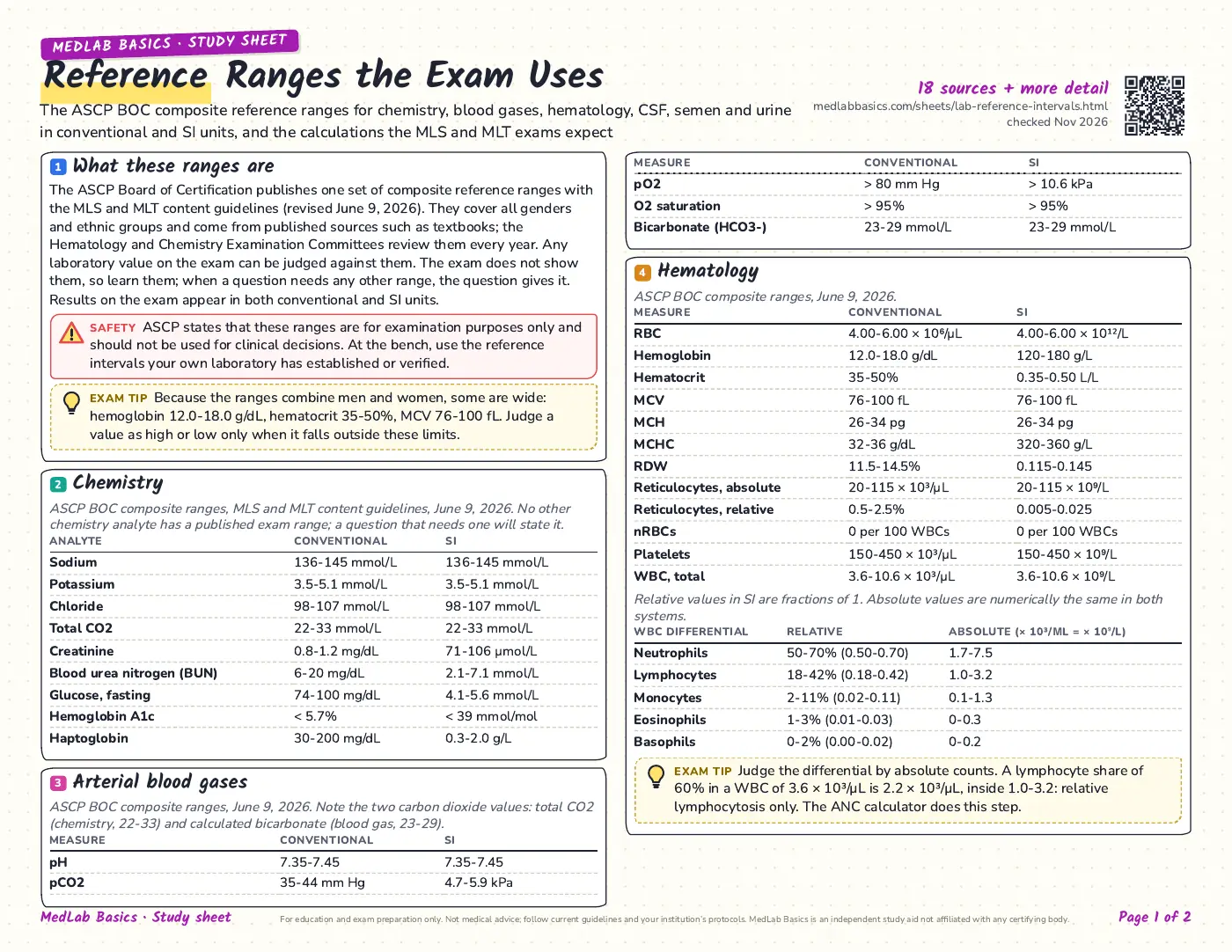
The ASCP BOC composite reference ranges for chemistry, blood gases, hematology, CSF, semen and urine in conventional and SI units, and the calculations the MLS and MLT exams expect
The ASCP Board of Certification publishes one set of composite reference ranges with the MLS and MLT content guidelines (revised June 9, 2026). They cover all genders and ethnic groups and come from published sources such as textbooks; the Hematology and Chemistry Examination Committees review them every year. Any laboratory value on the exam can be judged against them. The exam does not show them, so learn them; when a question needs any other range, the question gives it. Results on the exam appear in both conventional and SI units.
Chemistry
ASCP BOC composite ranges, MLS and MLT content guidelines, June 9, 2026. No other chemistry analyte has a published exam range; a question that needs one will state it.
Analyte
Conventional
SI
Sodium
136-145 mmol/L
136-145 mmol/L
Potassium
3.5-5.1 mmol/L
3.5-5.1 mmol/L
Chloride
98-107 mmol/L
98-107 mmol/L
Total CO2
22-33 mmol/L
22-33 mmol/L
Creatinine
0.8-1.2 mg/dL
71-106 µmol/L
Blood urea nitrogen (BUN)
6-20 mg/dL
2.1-7.1 mmol/L
Glucose, fasting
74-100 mg/dL
4.1-5.6 mmol/L
Hemoglobin A1c
< 5.7%
< 39 mmol/mol
Haptoglobin
30-200 mg/dL
0.3-2.0 g/L
Arterial blood gases
ASCP BOC composite ranges, June 9, 2026. Note the two carbon dioxide values: total CO2 (chemistry, 22-33) and calculated bicarbonate (blood gas, 23-29).
Measure
Conventional
SI
pH
7.35-7.45
7.35-7.45
pCO2
35-44 mm Hg
4.7-5.9 kPa
pO2
> 80 mm Hg
> 10.6 kPa
O2 saturation
> 95%
> 95%
Bicarbonate (HCO3-)
23-29 mmol/L
23-29 mmol/L
Hematology
ASCP BOC composite ranges, June 9, 2026.
Measure
Conventional
SI
RBC
4.00-6.00 × 10⁶/µL
4.00-6.00 × 10¹²/L
Hemoglobin
12.0-18.0 g/dL
120-180 g/L
Hematocrit
35-50%
0.35-0.50 L/L
MCV
76-100 fL
76-100 fL
MCH
26-34 pg
26-34 pg
MCHC
32-36 g/dL
320-360 g/L
RDW
11.5-14.5%
0.115-0.145
Reticulocytes, absolute
20-115 × 10³/µL
20-115 × 10⁹/L
Reticulocytes, relative
0.5-2.5%
0.005-0.025
nRBCs
0 per 100 WBCs
0 per 100 WBCs
Platelets
150-450 × 10³/µL
150-450 × 10⁹/L
WBC, total
3.6-10.6 × 10³/µL
3.6-10.6 × 10⁹/L
Relative values in SI are fractions of 1. Absolute values are numerically the same in both systems.
WBC differential
Relative
Absolute (× 10³/µL = × 10⁹/L)
Neutrophils
50-70% (0.50-0.70)
1.7-7.5
Lymphocytes
18-42% (0.18-0.42)
1.0-3.2
Monocytes
2-11% (0.02-0.11)
0.1-1.3
Eosinophils
1-3% (0.01-0.03)
0-0.3
Basophils
0-2% (0.00-0.02)
0-0.2
Body fluids
Cerebrospinal fluid
Conventional
SI
WBC and RBC
0-5/µL
0-5 × 10⁶/L
Glucose
50-80 mg/dL
2.8-4.4 mmol/L
Protein
15-45 mg/dL
150-450 mg/L
The MLT guideline lists only volume and sperm concentration; the MLS guideline lists all seven.
Seminal fluid
Conventional
SI
Volume
2-5 mL
2-5 mL
Sperm concentration
> 20 × 10⁶/mL
> 20 × 10⁹/L
Liquefaction (MLS list)
30-60 minutes
30-60 minutes
pH (MLS list)
7.2-8.0
7.2-8.0
Motility (MLS list)
> 50% within 1 hour
> 50% within 1 hour
Morphology (MLS list)
> 30% normal forms
> 30% normal forms
WBC (MLS list)
< 1 × 10⁶/mL
< 1 × 10⁹/L
ASCP BOC composite ranges, June 9, 2026. Any cast other than a few hyaline casts is outside the range.
Urine
Conventional
SI
Specific gravity
1.003-1.035
1.003-1.035
pH
4.5-8.0
4.5-8.0
Protein
< 10 mg/dL, trace or negative
< 0.1 g/L, trace or negative
Glucose
≤ 15 mg/dL or negative
≤ 0.8 mmol/L or negative
Ketones
< 5 mg/dL or negative
< 0.5 mmol/L or negative
Urobilinogen
< 1.0 EU
< 17.0 µmol/L
Bilirubin, blood, nitrite, leukocyte esterase
Negative
Negative
RBC (microscopic)
0-3/HPF
0-3/HPF
WBC (microscopic)
0-8/HPF
0-8/HPF
Casts (microscopic)
0-2 hyaline/LPF
0-2 hyaline/LPF
Epithelial cells (microscopic)
0-5/HPF
0-5/HPF
Calculations the exam expects
The list is the guideline's; the formulas are the standard forms, worked through step by step on the Laboratory Math page.
Calculation
Formula
In the app
Transferrin saturation, UIBC, TIBC
TIBC = serum iron + UIBC. Saturation (%) = serum iron ÷ TIBC × 100
By hand
Unconjugated (indirect) bilirubin
Indirect = total bilirubin − direct bilirubin
By hand
LDL (Friedewald) and non-HDL
LDL = TC − HDL − TG ÷ 5 (mg/dL; TG ÷ 2.2 in mmol/L). Not valid with TG above 400 mg/dL. Non-HDL = TC − HDL
LDL Friedewald calculator
A/G ratio
Globulin = total protein − albumin. A/G = albumin ÷ globulin
By hand
Timed urine
Amount per collection = concentration × total volume (match units: mg/dL × dL, or mg/L × L)
By hand
Creatinine clearance
CrCl (mL/min) = U × V ÷ P; V in mL/min (24 h = 1,440 min). Normalized = CrCl × 1.73 ÷ BSA (m²)
Measured Creatinine Clearance calculator
Beer's law
A = a × b × c, so concentration is proportional to absorbance. C unknown = (A unknown ÷ A standard) × C standard. A = 2 − log %T
Beer's Law calculator
WBC corrected for nRBCs (exam: more than 10 per 100 WBCs)
The summary above is what the PDF prints. These sections go further.
Reading conventional and SI units
Conventional units are those most US laboratories report (mass per deciliter, cells per microliter, percent). SI units use moles for substances of known molar mass, liters as the volume, and fractions in place of percent. The exam shows both, so either column of the tables above answers the question. To convert mg/dL to mmol/L, multiply by 10 (deciliters to liters) and divide by the molar mass in g/mol: glucose is 180 g/mol, so 10 ÷ 180 = 0.0555.
Factors worked back from the guideline's own conventional and SI pairs; they match the Conventional and SI Units calculator.
Units that do not change: sodium, potassium, chloride, total CO2 and bicarbonate are already in mmol/L; pH, specific gravity, MCV (fL) and MCH (pg) have no conversion.
A count per microliter becomes a count per liter by multiplying by 10⁶: so 10³/µL is 10⁹/L, and CSF cells 5/µL are 5 × 10⁶/L.
Semen counts per mL become counts per L by multiplying by 10³: 20 × 10⁶/mL is 20 × 10⁹/L.
HbA1c is reported as NGSP percent (conventional) or IFCC mmol/mol (SI); the guideline pairs < 5.7% with < 39 mmol/mol. The two scales are not related by a simple multiplier.
Round only at the end of a calculation; a converted value that differs from the guideline in the last digit is a rounding difference, not a different range.
ASCP Board of Certification. Medical Laboratory Scientist, MLS(ASCP) and MLS(ASCPi), Examination Content Guideline: Additional calculations and reference ranges. Revised June 9, 2026. Link
ASCP Board of Certification. Medical Laboratory Technician, MLT(ASCP) and MLT(ASCPi), Examination Content Guideline: Additional calculations and reference ranges. Revised June 9, 2026. Link
Gulati G, Uppal G, Gong J. Unreliable automated complete blood count results: causes, recognition, and resolution. Ann Lab Med. 2022;42(5):515-530. doi:10.3343/alm.2022.42.5.515 Link
Hong J, Gu H, Lee J, et al. Intuitive modification of the Friedewald formula for calculation of LDL-cholesterol. Ann Lab Med. 2023;43(1):29-37. doi:10.3343/alm.2023.43.1.29 Link
Friedewald WT, Levy RI, Fredrickson DS. Estimation of the concentration of low-density lipoprotein cholesterol in plasma, without use of the preparative ultracentrifuge. Clin Chem. 1972;18(6):499-502 (citation record). doi:10.1093/clinchem/18.6.499 Link
Al Dhuhli R, Al Riyami N, Al Farsi F, et al. Comparison of conventional formulas and machine learning models for estimating serum low-density lipoprotein cholesterol. Pract Lab Med. 2026;49:e00524 (Friedewald in mmol/L: TC − HDL − TG/2.2). doi:10.1016/j.plabm.2026.e00524 Link
Alpdemir M, Alpdemir MF, Şeneş M. Comparison of Friedewald, Martin/Hopkins, and Sampson formulae with direct LDL measurement in hyperlipidaemic and normolipidaemic adults in a Turkish population. J Med Biochem. 2024;43(5):671-680. Link
Kågedal B, Helldén A, Nezirević Dernroth D, et al. Determination of glomerular filtration rate after contrast-enhanced CT among critically ill patients: support for a new procedure. Crit Care Explor. 2025;7(5):e1269 (clearance normalized by × 1.73/BSA). Link
Ishikawa S, Miyazawa R, Yokoyama F. Hypoglycemia and altered bile acid metabolism are linked to latent iron deficiency in young Japanese women. J Clin Biochem Nutr. 2026;79(2):158-162 (methods: TIBC = serum iron + UIBC). doi:10.3164/jcbn.25-279 Link
Borisova J, Morshchinin IV, Nazarova VI, et al. Low-cost microalgae cell concentration estimation in hydrochemistry applications using computer vision. Sensors (Basel). 2025;25(15):4651 (hemocytometer chamber depth and Neubauer square size). doi:10.3390/s25154651 Link
Mayerhöfer TG, Pahlow S, Popp J. The Bouguer-Beer-Lambert law: shining light on the obscure. ChemPhysChem. 2020;21(18):2029-2046. doi:10.1002/cphc.202000464 Link
Merck Manual Professional Version. Dyslipidemia (non-HDL cholesterol). Full review May 2025. Link
Merck Manual Professional Version. Evaluation of anemia (reticulocyte count as percent or absolute count). Full review October 2026. Link
Testing.com (ADLM). Transferrin and iron-binding capacity (TIBC, UIBC). Link
 MedLab Basics