 MedLab Basics
Exam guide
ASCP MLT Exam Guide
The Medical Laboratory Technician exam: format, content areas, what MLT leaves out, routes, a 6-week study plan, and moving up to MLS
Practice ASCP MLT questions free
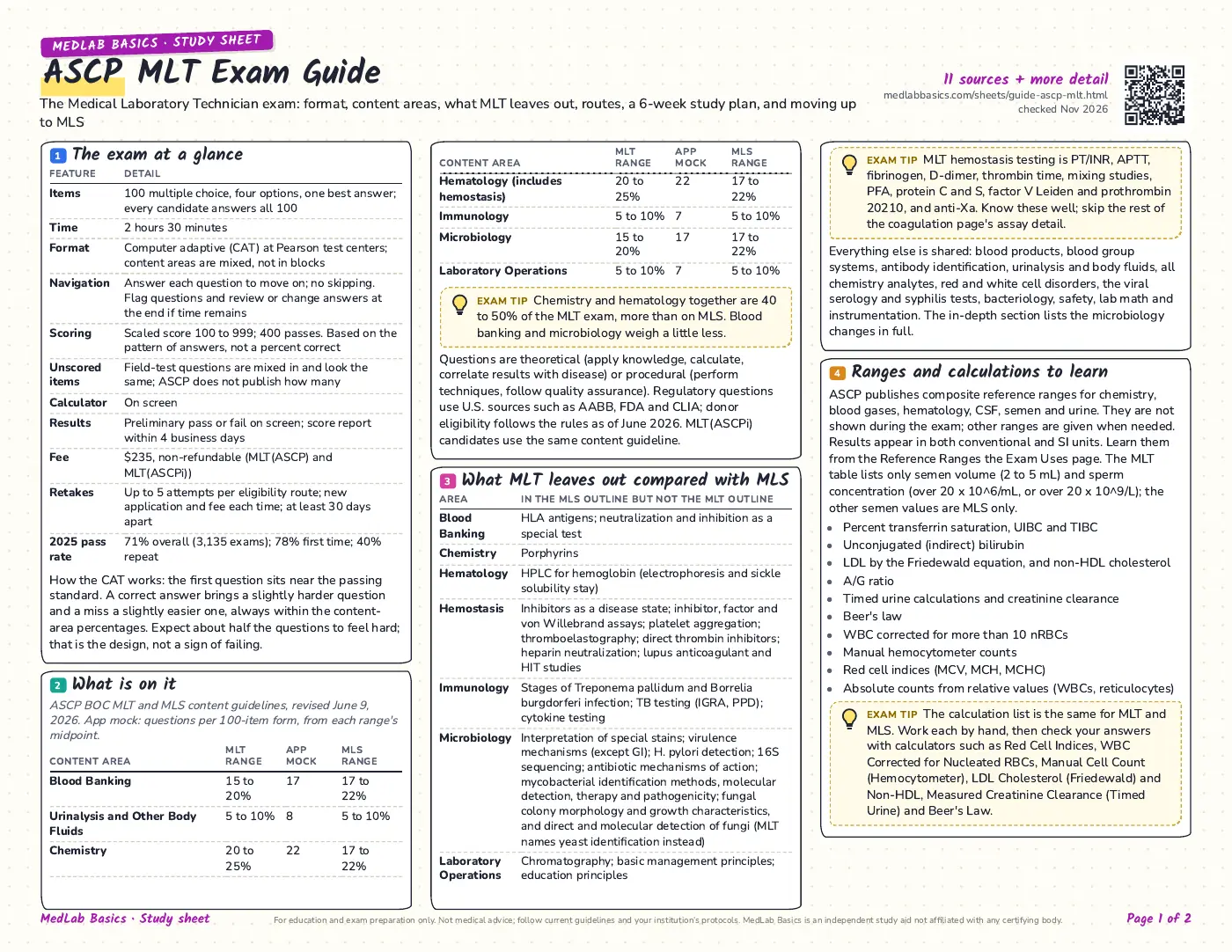
The exam at a glance
| Feature | Detail |
|---|---|
| Items | 100 multiple choice, four options, one best answer; every candidate answers all 100 |
| Time | 2 hours 30 minutes |
| Format | Computer adaptive (CAT) at Pearson test centers; content areas are mixed, not in blocks |
| Navigation | Answer each question to move on; no skipping. Flag questions and review or change answers at the end if time remains |
| Scoring | Scaled score 100 to 999; 400 passes. Based on the pattern of answers, not a percent correct |
| Unscored items | Field-test questions are mixed in and look the same; ASCP does not publish how many |
| Calculator | On screen |
| Results | Preliminary pass or fail on screen; score report within 4 business days |
| Fee | $235, non-refundable (MLT(ASCP) and MLT(ASCPi)) |
| Retakes | Up to 5 attempts per eligibility route; new application and fee each time; at least 30 days apart |
| 2025 pass rate | 71% overall (3,135 exams); 78% first time; 40% repeat |
How the CAT works: the first question sits near the passing standard. A correct answer brings a slightly harder question and a miss a slightly easier one, always within the content-area percentages. Expect about half the questions to feel hard; that is the design, not a sign of failing.
What is on it
| Content area | MLT range | App mock | MLS range |
|---|---|---|---|
| Blood Banking | 15 to 20% | 17 | 17 to 22% |
| Urinalysis and Other Body Fluids | 5 to 10% | 8 | 5 to 10% |
| Chemistry | 20 to 25% | 22 | 17 to 22% |
| Hematology (includes hemostasis) | 20 to 25% | 22 | 17 to 22% |
| Immunology | 5 to 10% | 7 | 5 to 10% |
| Microbiology | 15 to 20% | 17 | 17 to 22% |
| Laboratory Operations | 5 to 10% | 7 | 5 to 10% |
Questions are theoretical (apply knowledge, calculate, correlate results with disease) or procedural (perform techniques, follow quality assurance). Regulatory questions use U.S. sources such as AABB, FDA and CLIA; donor eligibility follows the rules as of June 2026. MLT(ASCPi) candidates use the same content guideline.
What MLT leaves out compared with MLS
| Area | In the MLS outline but not the MLT outline |
|---|---|
| Blood Banking | HLA antigens; neutralization and inhibition as a special test |
| Chemistry | Porphyrins |
| Hematology | HPLC for hemoglobin (electrophoresis and sickle solubility stay) |
| Hemostasis | Inhibitors as a disease state; inhibitor, factor and von Willebrand assays; platelet aggregation; thromboelastography; direct thrombin inhibitors; heparin neutralization; lupus anticoagulant and HIT studies |
| Immunology | Stages of Treponema pallidum and Borrelia burgdorferi infection; TB testing (IGRA, PPD); cytokine testing |
| Microbiology | Interpretation of special stains; virulence mechanisms (except GI); H. pylori detection; 16S sequencing; antibiotic mechanisms of action; mycobacterial identification methods, molecular detection, therapy and pathogenicity; fungal colony morphology and growth characteristics, and direct and molecular detection of fungi (MLT names yeast identification instead) |
| Laboratory Operations | Chromatography; basic management principles; education principles |
Everything else is shared: blood products, blood group systems, antibody identification, urinalysis and body fluids, all chemistry analytes, red and white cell disorders, the viral serology and syphilis tests, bacteriology, safety, lab math and instrumentation. The in-depth section lists the microbiology changes in full.
Ranges and calculations to learn
ASCP publishes composite reference ranges for chemistry, blood gases, hematology, CSF, semen and urine. They are not shown during the exam; other ranges are given when needed. Results appear in both conventional and SI units. Learn them from the Reference Ranges the Exam Uses page. The MLT table lists only semen volume (2 to 5 mL) and sperm concentration (over 20 x 10^6/mL, or over 20 x 10^9/L); the other semen values are MLS only.
- Percent transferrin saturation, UIBC and TIBC
- Unconjugated (indirect) bilirubin
- LDL by the Friedewald equation, and non-HDL cholesterol
- A/G ratio
- Timed urine calculations and creatinine clearance
- Beer's law
- WBC corrected for more than 10 nRBCs
- Manual hemocytometer counts
- Red cell indices (MCV, MCH, MCHC)
- Absolute counts from relative values (WBCs, reticulocytes)
Who can take it
| Route | Requirements for MLT(ASCP) |
|---|---|
| Route 1 | Associate degree or 60 semester hours (90 quarter hours) of college credit, plus a NAACLS- or ABHES-accredited MLT program finished within the last 5 years |
| Route 2 | Discontinued January 1, 2023 |
| Route 3 | Associate degree or 60 semester hours with 6 semester hours of chemistry and 6 of biology, plus a 50-week U.S. military medical laboratory course within the last 10 years |
| Route 4 | Associate degree or 60 semester hours with 6 of chemistry and 6 of biology, plus 3 years of full-time clinical experience in all six areas, in an acceptable laboratory, within the last 6 years |
Students in an accredited program should apply no more than 6 weeks before finishing it. The exam must be taken within the eligibility period on the admission notice; periods are not extended.
How to study: 6 weeks
- Week 1: take a timed 100-question app Mock Exam as a baseline. Read the MLT content guideline and the Reference Ranges the Exam Uses page, then start Daily Review.
- Week 2: hematology, with the Red Cell Morphology and the Anemias, CBC, Analyzers and Spurious Results, White Cells, Leukemia and Lymphoma, and Hemostasis and Coagulation Testing pages. Practice with the Red Cell Indices, Reticulocyte Count, WBC Corrected for Nucleated RBCs, Manual Cell Count (Hemocytometer) and Absolute Neutrophil Count (ANC) calculators.
- Week 3: chemistry, with the Clinical Chemistry: Analytes and Disease Patterns; Electrolytes, Acid-Base and Blood Gases; Endocrinology, Drug Monitoring and Toxicology; and Chemistry Methods and Instrumentation pages. Practice with the LDL Cholesterol (Friedewald), Measured Creatinine Clearance, Anion Gap, Serum Osmolality and Beer's Law calculators, and work transferrin saturation and indirect bilirubin by hand.
- Week 4: blood banking, with the ABO, H and Rh Typing; Antibody Screen and Identification; Compatibility Testing and Blood Components; and Transfusion Reactions and HDFN pages. Work every antigram row by row.
- Week 5: microbiology (Gram Stain and Bacterial Identification; Specimens, Cultures and Susceptibility Testing; Mycobacteria, Fungi, Parasites and Viruses), then urinalysis and body fluids (Urinalysis; Body Fluids) and immunology (Immunology and Serology), with practice in each content area. Keep the microbiology outline differences in the in-depth section beside you.
- Week 6: laboratory operations, with the Quality Control, Validation and Regulation; Laboratory Safety and Biosafety; and Laboratory Mathematics pages and practice in that content area, with the Westgard Rules Check, QC Statistics and Solution Dilution calculators. Take two more Mock Exams, then work Missed Questions and your Weakest Subject until test day.
Test-day tips
- Pace: 150 minutes for 100 questions is 90 seconds each. Bank time on recall questions for the calculations.
- You cannot skip. Pick your best answer, flag the question, and come back if time remains.
- Every question counts the same to you: field-test items cannot be told apart, so give each full effort.
- Use the on-screen calculator, and write units at every step.
- Results and ranges are shown in both conventional and SI units; use whichever you learned, but check the units before you compare.
- Each question stands alone, with three plausible wrong options. Read the last line of the stem first, then the data.
After you pass, and moving up to MLS
- The credential is MLT(ASCP), written MLT(ASCP)CM (CM in superscript) while you take part in the Credential Maintenance Program.
- It is valid for 3 years. Renew with 36 CMP points per cycle: 2 each in blood banking, chemistry, hematology and microbiology, 1 in laboratory or patient safety, 1 in medical ethics, and 26 in your specialty or related areas. CMP fee $110.
- Since January 2026 new credentials come as a Credly digital badge instead of a wall certificate.
- If you fail, the score report breaks your result down by content area. Use it to aim the next round of study.
| MLS Route 2: MLT to MLS | Requirement |
|---|---|
| Certification | Valid MLT(ASCP) |
| Degree | Bachelor's degree |
| Science | 16 semester hours of biology (including 1 semester of microbiology) and 16 of chemistry (including 1 semester of organic chemistry or biochemistry) |
| Experience | 2 years of full-time clinical experience in an acceptable laboratory within the last 5 years |
| Fee | $260, the MLS application fee |
ASCP resources
- MLT credential page (routes and fee): ascp.org/boc, Explore Credentials, MLT
- MLT(ASCP) and MLT(ASCPi) Examination Content Guideline, revised June 9, 2026 (PDF linked from the MLT page)
- About the Examination and After the Examination: ascp.org/boc, Examination Process
- CMP requirements for MLT: ascp.org/boc, Maintain Your Credentials
- ASCP also sells a BOC Study Guide and BOC Interactive Practice Examinations.
MedLab Basics is an independent study aid. It is not affiliated with, endorsed by, or sponsored by the American Society for Clinical Pathology (ASCP) or the ASCP Board of Certification (BOC). MLS(ASCP) and MLT(ASCP) are credentials of the ASCP Board of Certification. Exam names and trademarks belong to their respective owners.
In depth
The summary above is what the PDF prints. These sections go further.
The outline differences in full
A line-by-line comparison of the two June 9, 2026 guidelines. Where an item is not listed here, it appears in both outlines in the same words.
| Outline section | MLS | MLT |
|---|---|---|
| Blood group antigens | Includes HLA and platelet-specific | Platelet-specific only |
| Blood bank special tests | Includes neutralization/inhibition, thiol reagents, solid phase, column agglutination, chloroquine, EDTA glycine-acid | The same without neutralization/inhibition |
| Heme derivatives | Includes porphyrins | No porphyrins |
| Hemoglobin, qualitative | Electrophoresis, HPLC, sickle solubility | Electrophoresis, sickle solubility |
| Hemostasis disease states | Factor deficiencies, inhibitors, fibrinolytic system, hypercoagulable states, DIC | The same without inhibitors |
| Hemostasis tests | 16 items, through factor, inhibitor and vWF assays, aggregation, TEG, DTIs and heparin neutralization | PT/INR, APTT, fibrinogen, D-dimer, TT, mixing studies, PFA, protein C and S, FVL and prothrombin 20210, anti-Xa |
| Infectious disease serology | Viral pathogens; stages of T. pallidum and B. burgdorferi infection; TB infection (IGRA, PPD) | Viral pathogens (hepatitis A, B, C, EBV, HIV, CMV, rubella, measles) |
| Serologic procedures | ANA, thyroid antibodies, RF, labeled immunoassays, nontreponemal and treponemal syphilis tests, immunofluorescence, cytokines | The same without cytokine testing |
| Microbiology stains | Procedure, principle and interpretation for Gram, acid-fast, modified acid-fast, KOH and calcofluor, trichrome, Giemsa, acridine orange | Procedure, principle and interpretation for Gram and acid-fast; procedure and principle only for the other five |
| Pathogenicity by body site | Etiology, transmission and virulence mechanisms | Etiology and transmission; virulence mechanisms kept for GI only |
| GI tract | Includes H. pylori detection methods | No H. pylori item |
| Identification methods | Includes 16S sequencing | No sequencing |
| Susceptibility testing | Includes mechanisms of action of major antibiotic classes | No mechanisms of action; resistance determinants and intrinsic resistance stay |
| Mycobacteria and Nocardia | Sources, pathogens, AFB and growth, identification methods, molecular detection, therapy, pathogenicity | Sources, pathogens, acid-fast reaction, colony morphology and growth |
| Parasitology | Microscopic and macroscopic identification | Microscopic identification |
| Mycology | Colony morphology and growth, microscopic ID, direct and molecular detection, other ID methods | Yeast identification (biochemical, automated, MALDI-TOF), microscopic ID, other ID methods |
| Methodology and instrumentation | Includes chromatography | No chromatography |
| Management and education | Basic management and education principles | Not on the MLT outline |
| Semen reference ranges | Volume, concentration, liquefaction, WBC, pH, motility, morphology | Volume and sperm concentration |
The outline lists topics, not depth. ASCP does not say how much deeper MLS questions go on the topics both exams share, so study shared topics fully.
Planning the move to MLS
- MLS Route 2 is the route built for MLT(ASCP) holders. Note that MLT Route 2 is a different, discontinued route.
- The 2 years of experience must be in an acceptable laboratory (CMS CLIA, DoD CLIP, JCI or ISO 15189) and cover blood bank, chemistry, hematology, microbiology, immunology and urinalysis and body fluids, though not the full time in each.
- Other MLS routes stay open: Route 1 (bachelor's degree plus a NAACLS-accredited MLS program within 5 years) and Route 4 (bachelor's with the same science hours plus 5 years of experience in the last 10).
- The MLS exam has the same length, time, scale and passing score. Its range midpoints move 3 points off chemistry and hematology each, and 2 points onto blood banking and microbiology each.
- To prepare, add the items in the differences table: HLA, the full coagulation assay list, porphyrins, HPLC, syphilis and Lyme stages, IGRA, mycobacterial identification methods and therapy, fungal colony morphology and growth, chromatography, and management and education principles.
2025 context: MLS(ASCP) first-time pass rate 77%, MLT(ASCP) 78%. MLT Route 1 graduates of NAACLS programs passed at 72% and of ABHES programs at 53%.
Sources
- ASCP Board of Certification. Medical Laboratory Technician, MLT(ASCP) and MLT(ASCPi) Examination Content Guideline. Revised June 9, 2026. Link
- ASCP Board of Certification. Medical Laboratory Scientist, MLS(ASCP) and MLS(ASCPi) Examination Content Guideline. Revised June 9, 2026. Link
- ASCP Board of Certification. Medical Laboratory Technician (MLT) credential page: eligibility routes and fee. Accessed November 15, 2026. Link
- ASCP Board of Certification. Medical Laboratory Scientist (MLS) credential page: eligibility routes and fee. Accessed November 15, 2026. Link
- ASCP Board of Certification. About the Examination. Accessed November 15, 2026. Link
- ASCP Board of Certification. After the Examination. Accessed November 15, 2026. Link
- ASCP Board of Certification. Application Policies. Accessed November 15, 2026. Link
- ASCP Board of Certification. Credential Maintenance Program requirements, MLT. Accessed November 15, 2026. Link
- ASCP Board of Certification. Citation of Credentials. Accessed November 15, 2026. Link
- ASCP Board of Certification. ASCP Examinations & Credentials, Insights & Analytics 2025 (updated April 24, 2026). Link
- ASCP Board of Certification. ASCP Examination Readiness Resources. Accessed November 15, 2026. Link